 Drug
Verdict up top
The product is an operation, not an app: everything advertised maps to a behaviour you can observe — the key-only registration, the puzzle gate, the invoice address at checkout, the signature on every announcement. Community posts read like a userbase that has already been through at least one market collapse and knows what “hot wallet + password table + Dread support” costs in the seizure scenario. For buyers who want an active market with boring, auditable money flow, this is what it currently fills; for buyers who want pretty UI or hand-holding, the thread contains both complaints and the staff one-liner that answers them.
History & current position
Lineage per spec: the codebase was written from scratch; the previous market life was a merge that later became “SuperMarket”; six years of continuous operation after that. Then came the collapse era — Archetyp first (with a big user wave in), then Abacus, Incognito (after a founder arrest), Bohemia, Versus — which made DrugHub “the leading market after competitor collapses”, in the spec's own phrase.
The admin style is part of the product and documented in-market: “blunt, no-nonsense”, no Dread desk, tickets that wait, vendors told to register properly or be ignored, and one famous answer to slow-connection complaints — “if 99 % are working, and yours is not, the problem is on your side”. The same thread contains users praising exactly that posture (“support is great, the UI needs work but it's perfectly usable if you read what you're doing”).
The full audit — every claim row
Column one is the claim, column two what was actually checked, column three where it comes from:
| Area | Finding | Evidence |
|---|---|---|
| Age | 6 years operational | spec.market_name metadata |
| Code | Written from scratch, no fork lineage | spec.operational_notes |
| Login | No user/pass fields; signature challenge per session | spec.authentication + thread screenshots |
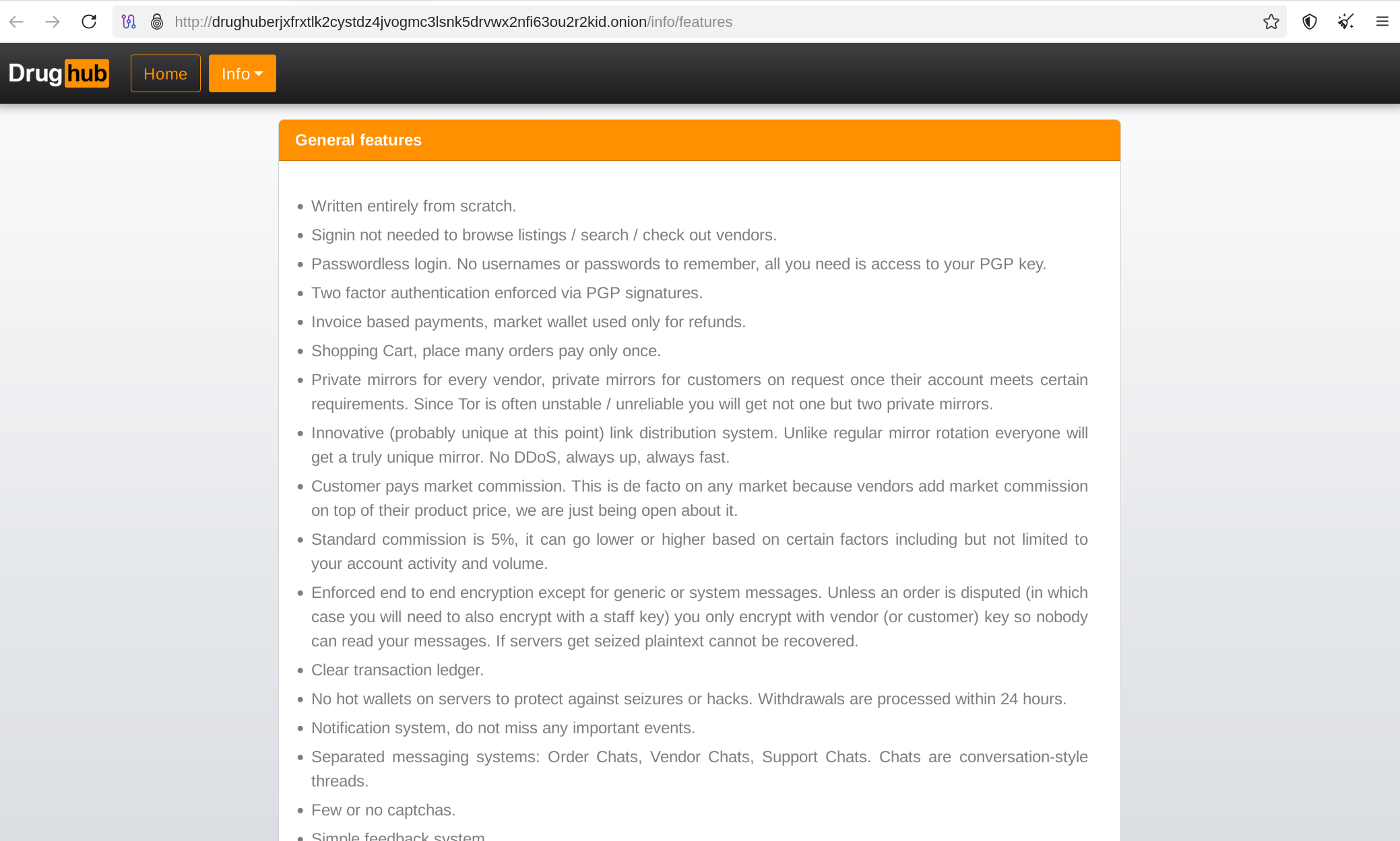
| Messaging | E2E PGP enforced; plaintext structurally impossible | spec.security_features + vendor rule quotes |
| Payments | XMR invoices, zero deposits, wallet = refunds/adjustments only | spec.payment_model + wallet-page quote in thread |
| Wallet infra | No hot wallets on servers; withdrawals offline ~24 h, fees covered | spec.payment_model |
| Access | PoW entry; unique private onions (vendor=2); constant attacks on mains noted by staff | spec + signed post + thread |
| Accounts | Purge at ~6 months inactivity; no email exists to warn you | thread confirmations (×2) + signed post |
| Support | Tickets + auto pages; 99.5 % auto-resolved; Dread: none; no expediting | spec.support + post |
| Vendors | Manual case-by-case applications; bond = key history; quick replies; staff sub-accounts; bulk orders; keyword/private listings; AF 5–45 d vendor-set; early-FE = discretion | spec.vendor_features + vendor section of post |
| Client tools | E2EE helper in Python (280 lines) / Go (290 lines), reverse-proxy, PGP-signed, no binaries, Tails/Whonix/Qubes/Debian | spec.encryption_helper |
| Bans | RU + CIS blocked (business + information sales) | spec.geopolitical_restrictions |
| Staff | Jabber notifications on the market's own private jabber server; jabber alerts to users | spec.features + market_description |
Money flow — the maths of one order
Worked example so nobody has to reconstruct it: order value 1 XMR. Vendor lists at 1.000; the fee is 0.050 customer-side; the invoice total is ≈1.050 XMR to a fresh address; nothing is held in escrow beyond the normal AF window (five to forty-five days, vendor-controlled; extendable up to about two weeks on the customer side — one vendor's griping comment about eighteen-day waits is the community-side view, and the documented escape is the dispute path “received order but won't release escrow”, with tracked shipments resolved “fairly quickly”). Withdrawal from the market wallet: offline, inside ~24 h, network fee on the house.
That single-address-per-order shape is why the zero-hot-wallet line is credible: a breach reads invoices, not balances, and the refund wallet is a different beast from trading funds. Community line that nails it: “the one-time XMR deposit per transaction is lovely… no leftover funds in the market wallet”.
Community sentiment — quotes, unedited
Pros / cons — flat list
- Six-year uptime through the whole collapse era
- Zero stored credentials; no DB-breach class
- Zero hot wallets; offline withdrawals; house-paid fees
- E2EE by enforcement, disputes stay encrypted
- Unique onions = DDoS isolation; vendor mirrors ×2
- 99.5 % ticket automation with published source
- Client-side helper tools, signed, no binaries
- 5 % on top of price, customer-side (community complaint)
- PGP + Monero prerequisite — how-to tickets closed
- Six-month purge, no warning (there is no email anyway)
- Self-service culture; AF-timer forgetfulness = your loss
- Entry PoW bites on weak/throttled CPUs
- RU + CIS fully blocked
- UI: functional, unpolished — minority griping noted
Who this fits
Fits: buyers who want to run orders without leaving balances on someone's box; vendors who already have a key-verifiable history (waiver is judged on exactly that); users who are fine on Tails/Whonix/Qubes and will read the signed announcements. Marginal: newcomers who have not touched a keypair — the friction is documented but real; buyers who read fee-on-top as a defect, though the numbers do not lie either way. Whatever your side, the entry artefacts are one hop away: the verified onion and copy box on the top page, the challenge/sign walkthrough on the login portal, and the invoice mechanics on the monero page.